Why Cricket Bat Grains Are Not a Quality Score
Cricket bat grains can help you read a blade’s appearance, but knowing their limits helps you judge feel, balance and workmanship with more confidence.
Cricket bat grains describe the visible lines on a blade, not its quality. They can help you inspect the willow’s appearance, but counting them cannot tell you how a bat will feel, perform or hold up. Handle the bat and inspect its construction before treating its face as anything more than one clue.
Cricket bat grains show the willow’s visible pattern
The lines on a bat face are visible growth rings in the willow. They run from the shoulder towards the toe and reflect the tree’s growth pattern. On some blades they appear clear and regular; on others they are less distinct or vary across the face.
Look at whether the lines run broadly straight and whether the face has other visible features, such as knots, blemishes or irregularities. These observations describe the surface in front of you. They do not amount to a full assessment of the wood or the bat.
A tidy-looking face cannot reveal everything beneath the surface. Grain is a visual clue, not a certificate of performance or durability.
A higher grain count does not make a better bat
A higher count means more visible lines across the face; it does not automatically mean a bat is better made or more suitable for you. A bat with fewer lines may be a sensible choice, while one with many may feel wrong in your hands.
Grain count is sometimes treated as a rough clue to how the willow grew, but it cannot settle how a particular bat will play. Bats with similar-looking faces can differ in weight distribution, shape, handle feel and workmanship. Counting lines gives those differences less attention than they deserve.
It is not worth taking a ruler to the shop or rejecting a bat because its grain count differs from a preferred number. If the bat feels manageable and its finish raises no obvious concern, those details matter more to your choice than another visible stripe.
Straight grains cannot certify a bat’s strength
Straight, regular lines may make a face look neat, but they do not reveal the whole internal structure. A bat’s durability depends on its wood, construction, preparation and use; grain appearance alone cannot establish it.
Inspect the face and edges for conspicuous defects without mistaking visual tidiness for proof of toughness. If a mark looks like a crack, or you are unsure whether a feature is structural, ask a knowledgeable bat seller or maker rather than diagnosing it from a photograph.
Grain spacing is no simple verdict either. Widely spaced lines do not by themselves show that a bat is weak, and close spacing does not certify a robust blade. Note the pattern, then assess the bat as a whole.
Judge a bat by feel, balance and workmanship
Start with the bat you will carry to the crease. Check whether the handle sits comfortably, the blade feels manageable and the balance suits your shots. A handsome face can belong to a bat that feels cumbersome; a less striking one may feel natural as soon as you pick it up.
- Weight and pick-up: Lift the bat in your normal grip. If it feels heavy through the hands, try another option; if it feels manageable, move on to checking its balance.
- Balance: Make a controlled practice movement. If the blade feels awkward to direct, compare another bat; if it moves comfortably, continue checking its shape and condition.
- Shape and edges: Look at the profile and how the wood is distributed. If the shape does not suit your intended use, try another profile; if it does, check the handle and grip.
- Handle and grip: Hold the bat as you normally would. If your grip feels strained or awkward, choose another handle or grip; if it feels comfortable, inspect the workmanship.
- Workmanship: Inspect the toe, shoulders, splice and finish. If you see damage or suspect poor assembly, ask the seller or maker before buying; if nothing concerns you, ask about preparation.
- Preparation: Ask whether the bat needs knocking-in or other preparation before use. If it does, follow the maker’s instructions; if it does not, ask how the maker recommends caring for it.
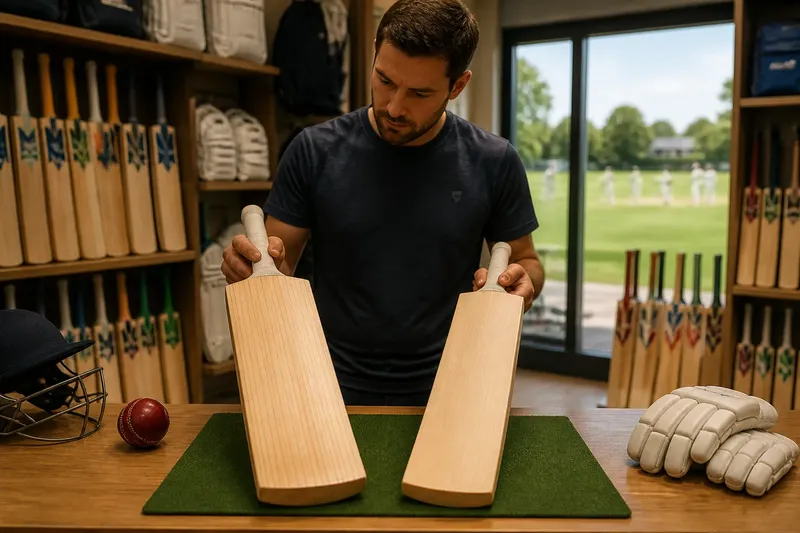
Say you are choosing between two bats for club cricket. The first has an even face and many visible lines but feels cumbersome when you lift it; the second has fewer lines, feels easier to control and has no obvious concern in its finish. You try each with the same controlled movement, then choose the second because it feels more manageable in your hands. The observable result is that its pick-up feels easier during that movement; this is a personal fit decision, not proof that it will suit every player.
Willow grades need the same careful reading
A grade may give more context than a grain count, but it still needs interpretation. Bat makers and retailers may use grades to describe features of the willow, including appearance. The labels are not a universal performance scale, and a higher grade does not make a bat the right choice for every player.
Ask what the seller means by the grade on that particular bat rather than assuming every shop uses the same criteria. Then compare the actual blade’s feel, balance, finish and visible condition. A label can explain what you are looking at; it should not replace handling the bat.
For an online purchase, look for clear photographs of the actual blade and information about its listed weight, profile and preparation. If a detail is missing, ask the seller before relying on a grain count or grade label alone.
What can grain count tell you about performance?
Grains cannot show how well a bat will suit your timing, technique or preferred shots. That fit depends on the player, the bat and the conditions of use. A visible feature of the wood cannot predict the combination.
If possible, handle the bat and compare it with another option of a similar size and intended use. Keep any trial movement controlled and follow the seller’s guidance. For an online purchase, consider the available specifications, photographs and return terms rather than deciding from a close-up of the grain alone.
What should you check about cricket bat grains?
Are fewer grains a warning sign?
Not by themselves. Treat them as one feature of the willow, then inspect the whole face and judge the bat’s feel and construction.
Should a beginner choose a bat with many grains?
Grain count cannot replace a suitable size, manageable pick-up and comfortable balance. Choose a bat you can control and prepare it as its maker recommends.
Can grains identify English willow or Kashmir willow?
The face alone is not a reliable way to identify the willow type. Ask the seller for the material description and check it against the product information.
What should you do about a dark mark or irregular line?
Do not assume every mark is damage or every irregularity harmless. Ask the maker or seller to explain it, especially if it resembles a crack or changes the surface.
Use grain appearance as one buying clue
Treat the face as something to inspect, not a rating to obey. Notice whether the grain is broadly straight and whether any visible feature warrants a question. Then give more weight to fit, balance and workmanship.
Cricket bat grains can help describe a blade, but they cannot make the buying decision for you. Choose a bat whose size, feel and finish suit your game, and keep its appearance in proportion. The lines are interesting; they are not a scoreboard.