The White-Clothing Myth: Cricket Kit Need Not Match
Cricket clothing depends on format and fixture rules. Learn how to check the dress code, sort club kit from personal items and choose practical layers.
Cricket clothing depends on the fixture, not on a universal rule that every player must wear white. Whites remain familiar in traditional multi-day cricket, while coloured strips are common in limited-overs matches; the competition or organiser settles what applies.
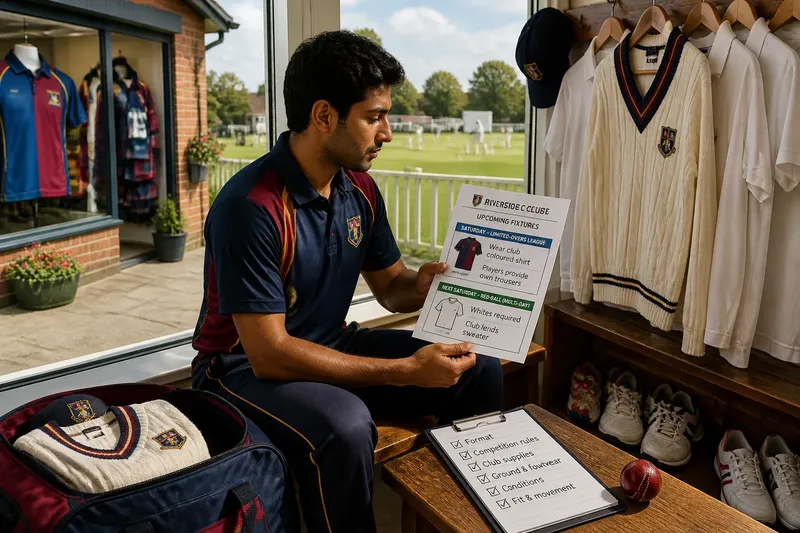
Say Riverside Cricket Club has a limited-overs league match this weekend and a longer red-ball fixture the following week. Imran, a new player, sees whites in the changing room and coloured shirts in a shop window. Before buying anything, he checks the fixture details and asks the organiser which kit each match requires.
Cricket clothing follows the fixture
Traditional multi-day cricket is strongly associated with whites: a light shirt and trousers, sometimes with a sweater in cooler conditions. That convention is familiar, but it is not a clothing law for every match.
Limited-overs cricket often uses coloured clothing, usually a coordinated team strip. A competition may set requirements for colours or design, while a recreational match may follow the club’s usual arrangements. Format offers a useful clue; the fixture instructions provide the answer.
School matches, social games and indoor sessions can follow different conventions from league cricket. A side might wear whites for a friendly because that is what players own, or coloured shirts for a limited-overs match because they are the club strip. Neither example establishes a rule for every ground.
Check the dress code before buying kit
Imran’s fixture notice identifies the first game as a limited-overs league match. The organiser confirms that players should wear the club’s coloured shirt. For the later multi-day match, the club uses whites. He has a clear answer for each fixture without treating the changing-room rail as a rulebook.
He then checks what the club supplies. The coloured shirt is issued by the team, but players provide their own trousers. For the white match, the club lends a sweater while players bring their own shirt and trousers. Cricket kit can be a mix of shared and personal items, not a single packaged uniform.
Use this order of checks when a fixture notice leaves something unclear:
- Check the listed format. If it is a multi-day or red-ball match, ask whether whites are expected; otherwise, check the stated strip rather than assuming.
- Check the competition instructions. If they specify colours or a uniform, follow that direction; if they do not, ask the organiser which club convention applies.
- Check which garments the club supplies. If the shirt or sweater is issued or lent, use it; if not, confirm what personal items you need before shopping.
- Check the ground surface. If the venue specifies footwear or restrictions, follow them; if the notice is silent, ask the organiser what shoes are suitable.
- Check the expected conditions. If cool weather calls for an extra layer, choose one that fits the club’s clothing arrangements; if it is warm, leave unnecessary layers behind.
- Check how the clothing moves when you raise your arms, bend and crouch. If it pulls or slips, choose another size or garment; if movement feels unrestricted, it is a more practical option.
For the fictional Riverside fixtures, the decision is straightforward: Imran uses the issued coloured shirt and personal trousers for the limited-overs match, then wears whites for the multi-day game and borrows the club sweater if conditions call for it. The trade-off is between buying extra clothing for convenience and using a club loan that may not always be available.
Fit, layers and footwear matter after colour
A shirt should let the arms move freely for throwing and batting. Trousers should remain comfortable when running, bending and crouching. A garment that looks right while standing still may be awkward during play, so ordinary movement is a better guide than appearance alone.
Layering depends on conditions. A sweater or light warm-up layer can help before play or in cool weather, but an extra layer may feel cumbersome once activity increases. A cap or sun hat is another personal choice, subject to the match arrangements and the player’s preference.
Footwear is a separate practical question. A hard court, artificial surface and grass wicket may call for different shoes. Check the venue or organiser’s guidance rather than assuming footwear suitable for one ground will suit another.
What should you check before choosing cricket clothing?
Do cricketers always wear white?
No. Whites are associated with traditional multi-day and red-ball cricket, while coloured kit is common in limited-overs formats. The specific competition or club arrangement takes precedence.
Can you wear coloured clothing in a red-ball match?
That depends on the competition’s requirements. Check the fixture instructions or ask the organiser rather than inferring permission from another format.
Does a cricket club supply the full uniform?
Arrangements vary: a club may issue a shirt, lend a sweater or expect players to provide most garments. Ask which items are supplied before buying anything.
What should you wear for changing weather?
Start with the organiser’s clothing requirements, then choose layers that suit the conditions and allow free movement. A removable sweater is easier to manage than a layer that cannot be taken off once play begins.
What is not worth the effort
Buying a complete matching set simply to make every garment agree in colour is rarely useful. An issued shirt, personal trousers and a borrowed sweater may be perfectly practical if they fit the match arrangements.
For cricket clothing, treat the format as a starting point and the fixture instructions as the decision point. Then check what the club provides, how the clothes move and what the ground requires. The useful distinction is not between authentic and inauthentic kit, but between clothing that suits this match and clothing chosen by guesswork.