Leather or Synthetic Cricket Balls: Choose by Playing Surface and Format
Leather or synthetic cricket balls suit different surfaces and formats. Learn how their construction affects bounce, grip, wear and the choice for your game.
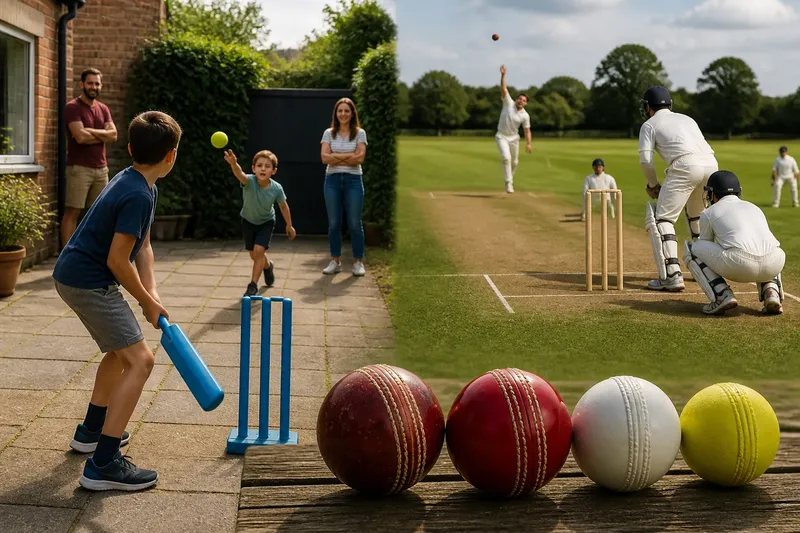
A leather or synthetic cricket ball belongs in a particular kind of game; choosing by appearance alone can leave players with a ball that behaves poorly on the surface or raises needless risk. The useful distinction is not simply natural material versus plastic, but how the ball is built and what the session expects it to do.
Leather balls are generally made with a leather outer and a stitched seam around a cork-and-winding core. Synthetic balls use manufactured outer materials, and their construction varies: some have a moulded surface, some have a seam-like ridge, and some combine a cover with a softer inner structure. Those differences affect grip, bounce, wear and how the ball meets a bat or a person. They do not make one type universally better.
Match the cricket ball to the setting
Start with the format and the surface, then consider the players and the purpose of the session. A leather ball is the normal choice for formal cricket and many adult club matches because its seam, mass and construction suit that style of play. A synthetic ball may be a better fit for a casual game, indoor use, a hard recreational surface or a session where a leather ball is not suitable.
Use the competition organiser’s specified ball for a fixture. For practice, ask the coach or venue what the surface and session are designed for. A ball that is acceptable for a soft indoor net may be unsuitable on a concrete yard; a hard leather ball is not a sensible default for a confined game with young or inexperienced players.
- Formal match or club net: choose the leather ball specified for the format and playing level. Its construction supports the familiar seam and bounce expected in those settings.
- Indoor hall or restricted space: use the ball approved by the venue or session organiser. A softer synthetic option may be appropriate where a hard ball would be unsuitable.
- Back garden or informal recreation: consider a synthetic ball suited to the surface and the group. It is often easier to use for a relaxed game, but the label and hardness still matter.
- Hard outdoor surface: select a ball expressly intended for that use. Neither “synthetic” nor “soft” describes every product, and a hard surface can make a poorly matched ball awkward or unsafe.
- Skill practice: use the ball that reflects the skill being practised. A synthetic ball can help with informal catching or bat-and-ball play, while seam movement and leather-ball handling require the relevant kind of ball.
Construction changes how the ball behaves
A leather ball’s stitched seam is a functional feature. Bowlers can use it to influence release and movement, and batters meet a firm, relatively dense ball with a distinct seam. The outer cover and core also mean that the ball can scuff, soften or lose its shape with use. How quickly that happens depends on the ball, the surface and how it is treated, so appearance is a cue rather than a reliable measure of its condition.
Synthetic covers are not one uniform material or design. A moulded surface may have a different feel from a stitched or ridged design. Some products are soft enough for introductory games; others are firm and intended for more active play. The seam-like line on a synthetic ball may help a bowler hold it, but it does not necessarily reproduce the seam, weight or response of a leather match ball.
For batting, those differences matter. A synthetic ball that is light or soft may not respond like a leather ball when it meets the bat. For bowling, the grip and seam presentation can feel different. For catching, a soft ball may be more suitable for a relaxed drill, while a firm ball demands the level of care and protection appropriate to its use. Treat each ball according to its actual construction, not its colour or a familiar-looking seam.
Choose by surface, space and players
On grass or a prepared cricket pitch, a leather ball is commonly used where the game calls for a regulation-style ball. On an indoor court, asphalt, paving or another hard recreational surface, the venue may specify a synthetic ball to suit the setting. The surface changes the experience: a ball can rebound sharply from a hard floor, while grass can slow it or affect its movement. The same ball does not produce the same session everywhere.
Space and the people playing matter as much as the ground. In a narrow garden, a firm ball may travel into windows or towards passers-by; a softer option may be more appropriate, provided it is designed for that activity. For children or beginners, a suitably soft ball can help make a first session less intimidating. That does not make every synthetic product suitable for every age or setting, and “soft” is not a substitute for sensible supervision.
Imagine a family playing in a paved courtyard, with a young beginner and little room behind the batter. A firm leather ball would be a poor match for that starting point. Choosing a soft synthetic ball intended for casual play, then keeping the game away from nearby windows, should make the activity more manageable; it will not teach the exact response of a leather-ball match. The choice follows from the space and players, not from a claim that synthetic balls are always safer.
What do players commonly ask about these balls?
Can a synthetic ball replace a leather ball in a match?
Only if the competition rules and organiser allow that type of ball. Even when it is permitted, its construction may produce a different feel and response, so it is not automatically an equivalent substitute.
Is every synthetic cricket ball soft?
No. Synthetic describes the outer material or construction, not a single level of firmness. Check the product description and intended use rather than judging by colour, size or a moulded seam.
Can a leather ball be used on any hard surface?
That is not a sound assumption. A hard surface can alter bounce and wear, and the setting may not be suitable for a firm ball. Use the type specified by the venue or organiser.
Does a synthetic seam produce the same movement as a leather seam?
Not necessarily. A raised line can offer a grip point, but the ball’s cover, core and overall response differ between products. A player practising with one should not assume it will behave like a leather match ball.
Check the product before buying or borrowing
Packaging and product descriptions can settle practical questions that a glance cannot. Look for the stated intended use, the type of cover, whether the ball is described as soft or firm, and any surface or age guidance. If the ball is borrowed, ask what it was supplied for. A worn leather ball may be unsuitable for a drill that depends on a reliable seam; a synthetic ball with a damaged cover may no longer behave as intended.
Rules and product directions vary by competition, manufacturer and venue, so follow the relevant instructions where they apply. If the purpose is formal cricket, use the ball the organiser specifies rather than trying to infer match suitability from a shop description.
There is little value in trying to make a synthetic ball imitate a leather one by adding tape, altering its surface or treating the seam. Such improvisation changes the object without making its response predictable. It is simpler to choose the right type for the session, or to change the drill to suit the ball available.
Keep the distinction clear when choosing
Leather and synthetic cricket balls overlap in broad purpose, but not in every playing context. Leather is the usual choice when a formal game or practice calls for a firm, stitched ball and its familiar seam response. Synthetic options cover a wider variety of casual, indoor and introductory uses, with meaningful differences in firmness and design from one product to another.
For a sound choice, identify the format, surface, available space and players first; then check the ball’s stated use. That simple order makes the difference between leather or synthetic cricket balls practical rather than cosmetic. When the setting is unsuitable for the ball in hand, change the ball or the activity, not the expectations placed on it.