How the Cricket Helmet Shifted from Cap to Purpose-Built Protection
The cricket helmet shifted from ordinary caps to purpose-built protection. Learn how its shell, faceguard and fit address distinct demands of batting.
The cricket helmet shifted from ordinary caps to purpose-built protection because a soft head covering could not address the risks of a rising ball. The change was not a neat sequence of five inventions: it was a gradual response to the demands of batting, with visibility and freedom of movement still to be preserved.
A cap covered the head without managing impact
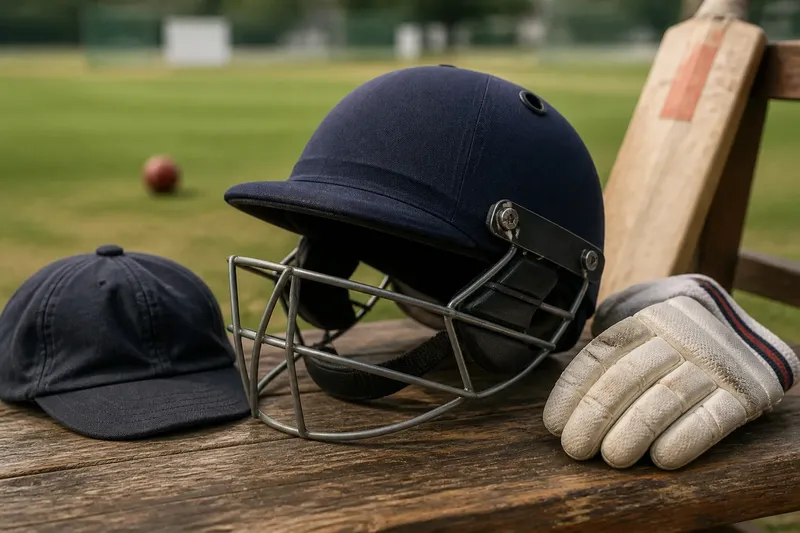
For much of cricket’s history, a batter’s head covering was an ordinary cap or cloth hat. It offered shade and suited the conventions of dress, but it was not built with a rigid shell, impact-absorbing lining or faceguard. Coverage and protection were different jobs.
As batters encountered faster bowling and balls that could rise towards the head, the limits of a cap were plain. A protective design also had to meet a practical constraint: the wearer needed to track the ball and turn the head freely. Adding material was not enough if it made batting harder to see.
Purpose-built headgear answered a different demand
In the later twentieth century, purpose-made cricket headgear began to appear in first-class and international cricket. The details and timing varied across players and equipment; it is more accurate to describe a gradual change than to assign the shift to one invention or a fixed sequence of stages. The important distinction was functional: headgear was being designed to protect the wearer, rather than merely to cover the head.
Early protective designs paired a hard covering with a faceguard intended to shield the face while leaving a view of the bowler and ball. Players still had to accept the discomforts of a more enclosed fit, warmth and bars in the sightline. A design that could not be worn comfortably through an innings was unlikely to become routine kit.
The shell and lining took on separate tasks
A helmet is a system, not simply a hard bowl. Its outer shell helps resist contact and distribute a blow; internal cushioning helps manage the force reaching the head. Padding and the retention system matter too: a helmet that shifts may leave areas less well covered.
Materials and construction vary by model. The wearer’s practical concern is whether the shell, padding, harness and faceguard work together as intended. A label and manufacturer’s instructions are more useful than judging protection from colour or a severe-looking shape.
The faceguard protects an area the shell cannot cover
A metal grille puts a barrier between the ball and parts of the face while leaving openings for sight and airflow. The shell covers the head, but cannot by itself protect the nose, mouth and jaw from a ball approaching from the front.
The grille’s position matters. It needs to give a clear view in a normal batting stance while keeping suitable coverage. Use a faceguard specified as compatible with the helmet model; a similar-looking attachment is not a reliable substitute. The grille reduces exposure to certain impacts, but it does not make the head a safe target.
Fit and compatibility shape how the helmet works
A helmet should sit level, cover the intended area and stay secure when the wearer turns or lowers the head. Padding should feel comfortable rather than loose or painfully tight, and the player should be able to see the ball through and around the grille. Head shapes differ, so the same nominal size may sit differently on two players.
Say a junior batter’s helmet tips forward whenever they look down at the crease. If the shell shifts out of position, the sensible action is to try another size or model and check the fit again; the expected result is a helmet that stays centred during ordinary head movement. Buying one to “grow into” leaves the current fit unresolved.
Check the manufacturer’s instructions for intended use, fit, compatible faceguards and care. If the helmet still feels unstable or the correct compatibility is unclear, ask a qualified coach or equipment specialist rather than improvising a combination.
What should you check before choosing a cricket helmet?
How should a cricket helmet fit?
It should sit level and remain secure when the wearer turns and lowers the head, without painful pressure. If it rocks or slips, try another size or model instead of relying on the grille to hold it in place.
Can any grille be fitted to any helmet?
No. Faceguards and attachment systems are designed for particular models, so check the manufacturer’s compatibility instructions. If the match is not specified, do not fit it by guesswork.
Does a helmet remove the risk of a head injury?
No. A helmet cannot remove every risk or make a dangerous delivery harmless. Use it as intended, alongside appropriate coaching and attention to playing conditions.
When should a cricket helmet be replaced?
Follow the maker’s guidance and inspect the shell, padding, harness and grille for damage. If a part is damaged or the helmet no longer fits securely, stop using it and seek suitable replacement advice; patching or modifying it is not a sound shortcut.
The cricket helmet’s shift from cap to purpose-built protection was a change in purpose, not merely appearance: shell, lining, faceguard and fit each address a different part of the problem. What is not worth the effort is choosing by colour or an aggressive-looking grille while ignoring fit and compatibility. Check those first; they are less theatrical and considerably more useful.